

Danila Petrov

Danila
Petrov
Consultant, Consulting & Valuation Department, Colliers Kazakhstan
Specializes in commercial real estate market research, analysis of project investment attractiveness, development of property development concepts, and preparation of analytical materials for developers and investors.
Holds two Bachelor’s degrees in Digital Innovations in Enterprise Management fr om the HSE University, Moscow, and Management and Digital Innovation from the University of London, London.
Trends in the Development of Shopping and Entertainment Centers in Kazakhstan in 2026
In 2026, Kazakhstan’s retail market continues to grow in quantitative terms; however, this growth is accompanied by weakening consumer purchasing power.
Since the beginning of the year, consumer lending has declined by 8% year-on-year, driven by stricter bank requirements for borrowers and higher lending rates. This has had a direct impact on consumer activity. Real household incomes decreased by 1.1% in 2025, making consumers more selective and shifting spending toward essential goods. As a result, retailers are being forced to adapt their product offerings and place greater emphasis on promotions and discounts. Against this backdrop, tax reform has also increased pressure on companies’ operating models. The increase in the standard VAT rate from 12% to 16%, combined with rising logistics and accounting costs, has reshaped cost structures and prompted companies to revise their pricing policies.
At the same time, Kazakhstan’s total retail turnover has increased by 93% over the past five years. This growth has been driven by the expansion of retail infrastructure, urbanization, and the development of e-commerce. As the market continues to grow in terms of volume while consumer demand becomes increasingly selective, new trends are emerging in the development of shopping and entertainment centers across Kazakhstan.
Overview of the Shopping Center Market in Almaty and Astana
Over the past several years, the gross leasable area (GLA) of high-quality retail space in Almaty has increased by 33%, from 661 thousand sq. m in 2017 to 881 thousand sq. m in 2026. Occupancy rates in Almaty’s shopping and entertainment centers remain consistently high, indicating strong demand from tenants. The high concentration of quality retail infrastructure in only a few districts highlights the need to develop neighborhood shopping centers in parts of the city that are less well served by retail space.
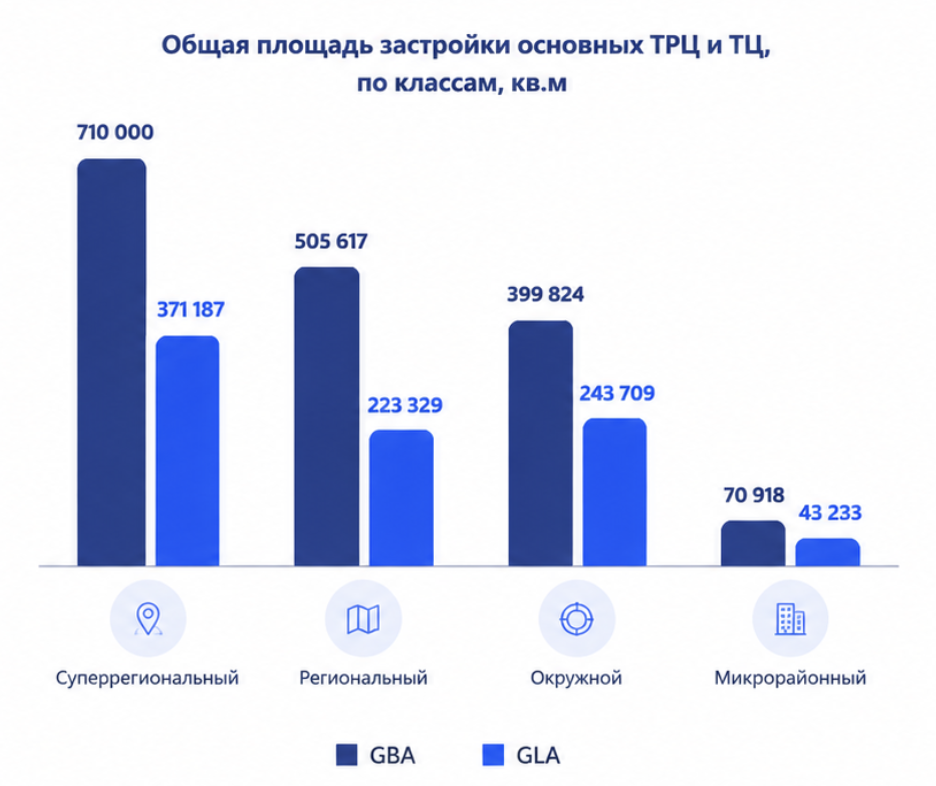
Total GLA of Major Shopping and Entertainment Centers and Shopping Centers in Almaty by Class, Q1 2026, sq. m
The “Clothing and Footwear” category accounts for the largest share of retail space across all shopping and entertainment centers in Almaty, traditionally remaining the most in-demand segment. Almaty also continues to see stable demand for space from entertainment and food and beverage operators, highlighting a shift toward an increasing share of service-oriented offerings within shopping centers.
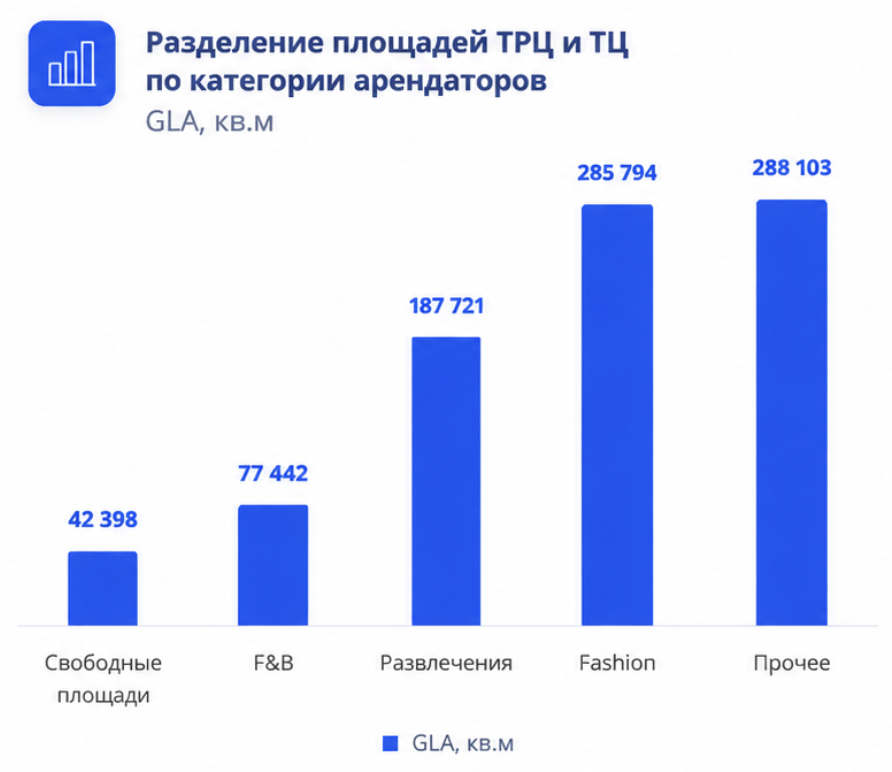
Breakdown of Shopping and Entertainment Center and Shopping Center Space in Almaty by Tenant Category, Q1 2026, sq. m
The total volume of high-quality retail space (GLA) in Almaty in 2026 amounts to 881 thousand sq. m. The weighted average rental rate is KZT 13,353 per sq. m per month, generating a maximum potential total rental income of KZT 141 billion per year, assuming 100% occupancy.
The shopping and entertainment center market in Astana has also demonstrated growth, increasing from 255 thousand sq. m of GLA in 2017 to 358 thousand sq. m of GLA in 2026, representing an increase of approximately 40%. Occupancy rates in Astana remain consistently high, although slightly lower than in Almaty.
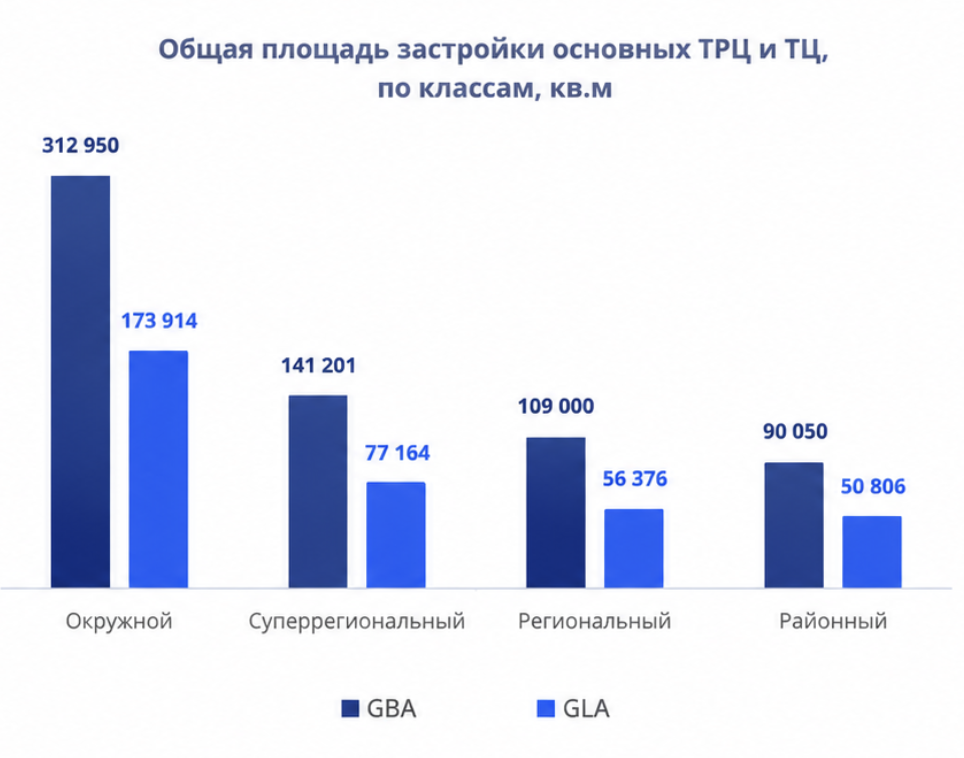
Total GLA of Major Shopping and Entertainment Centers and Shopping Centers in Astana by Class, Q1 2026, sq. m
As in Almaty, the Fashion category accounts for the largest share of retail space in Astana. At the same time, demand for entertainment and food and beverage segments is also growing, mirroring the trend observed in Almaty.
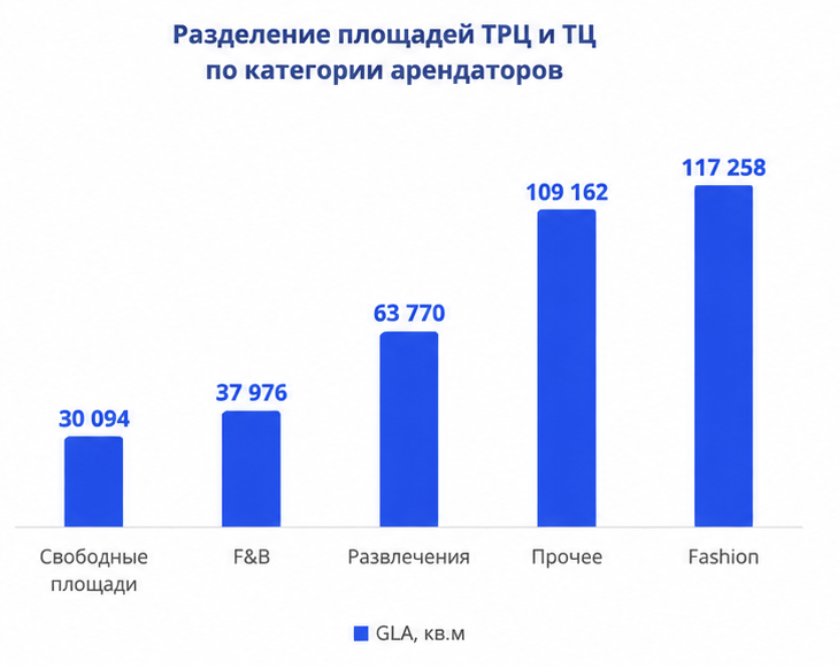
Breakdown of Shopping and Entertainment Center and Shopping Center Space in Astana by Tenant Category, Q1 2026, sq. m
The shopping and entertainment center market in Astana, despite having a relatively smaller total volume of space compared to Almaty, is characterized by higher rental rates. This makes the market promising for further development and expansion.
The total gross leasable area (GLA) of high-quality retail space in Astana in 2026 amounts to 358 thousand sq. m, with a weighted average rental rate of KZT 14,390 per sq. m per month. The maximum potential total rental income is KZT 62 billion per year, assuming 100% occupancy.
The majority of the expected new shopping and entertainment center openings across Almaty and Astana are located in Astana, including the shopping and entertainment center at Diamond MFC, Aspan Mall, MEGA Garden, and others. Based on the projects announced to date, the potential increase in market volume is approximately 69% in Astana, compared with around 1% in Almaty.
Experiential Retail
One of the key trends shaping the development of shopping and entertainment centers in Kazakhstan is experiential retail — a shift from the traditional retail model toward creating spaces wh ere visitors seek not only products, but also emotions, experiences, and impressions. Shopping and entertainment centers are no longer simply places for transactions; they are becoming part of consumers’ lifestyles, incorporating coworking spaces, leisure areas, workshops, pop-up zones, and cultural events.
This shift is largely driven by generational change. Younger audiences are increasingly choosing destinations that offer more than just shopping — they are looking for engaging leisure experiences. At the same time, shopping and entertainment centers are becoming smarter: AI-powered intelligent management systems enable operators to optimize infrastructure, manage visitor flows, and enhance security.
Taken together, these changes are reshaping the very logic of a successful shopping and entertainment center. Competitive advantage is increasingly determined not by size and location alone, but by the quality of the environment and the depth of visitor engagement.
Digitalization
Digitalization is transforming Kazakhstan’s shopping and entertainment center market on two levels — customer experience and operations. At the customer level, omnichannel integration is becoming a key tool: connecting online and offline channels allows customers to seamlessly switch between in-store purchases and online orders, manage loyalty rewards, and book services through a single mobile application.
At the property management level, smart sensors and devices, combined with AI and big data technologies, enable operators to optimize energy consumption, manage visitor flows, and enhance security. This is the same analytical toolkit that online platforms have been using for years, but it is now being introduced into physical shopping environments, improving the quality of operational decision-making and providing deeper insights into customer behavior.
Sustainable Development
The ESG agenda is gradually becoming part of the operational reality of shopping and entertainment centers in Kazakhstan. Properties are increasingly implementing energy-efficient systems, green building standards, and environmentally friendly materials. These measures not only help reduce operating costs over the long term but also increase the attractiveness of properties to tenants and visitors.
Globally, the transition to renewable energy sources and the use of solar panels are becoming increasingly widespread, enabling buildings to significantly reduce their carbon footprint. Environmental responsibility is also extending to tenants: property management companies are beginning to incorporate ESG criteria into lease terms, encouraging the use of environmentally friendly materials and energy-efficient solutions.
Taken together, sustainable development is no longer merely an image-building tool; it is becoming one of the factors determining the long-term competitiveness of shopping and entertainment centers.
Overall, the shopping and entertainment center market in Kazakhstan continues to demonstrate steady quantitative growth. However, structural changes in consumer behavior and tenant mix indicate that competition between properties is increasingly shifting toward qualitative differentiation. In this environment, experiential retail, digitalization, and sustainable development are no longer simply trends — they are becoming prerequisites for long-term competitiveness
.